Chelsea Flower Show 2026: Redefining Gardens with Wild, Natural Beauty

For decades, the Chelsea Flower Show has celebrated the manicured and the controlled. This year, nettles have arrived on the showground. Weeds are in. And the most powerful gardens are the ones designed to feel like somewhere you might actually want to sit and think.

There is a garden at Chelsea this year with a reclining figure carved from a fallen sequoia. Her willow hair flows into a dry-stone wall. Around her, nettles grow. Self-seeded wildflowers push through. Reclaimed objects sit alongside perennials chosen not for showiness but for what they feed at dusk, when the pollinators arrive.
This is Sarah Eberle's On the Edge garden, created for the Campaign to Protect Rural England's centenary, and it is perhaps the clearest statement of where British garden culture has arrived in 2026. Not manicured. Not controlled. Ecological and emotional in equal measure. A garden that asks a question rather than presenting an answer.
It is, by any measure, the garden of the moment.
What Chelsea Flower Show 2026 Is Really Saying

The RHS Chelsea Flower Show opened this week as it does every May, and the conversation it has started is not about plant varieties or colour palettes. It is about what we believe a garden is for.
As Ideal Home's Gardens Editor Sophie King observed: "Wild, naturalistic planting is a huge theme at this year's Show. Weeds, particularly nettles, are involved rather than excluded from a few of the gardens, and there are some really pretty flowering varieties like buttercups, too."
Jamie Butterworth, RHS ambassador and co-designer of Monty Don's dog garden in 2025, described a shift that has been building for years but has now reached the showground itself: "If you go back a decade, every plant, tree or hedge going to Chelsea would have to be beautifully manicured, with not even a hint of a bite out of a leaf, which meant everybody was growing them in pristine conditions."
The 2026 show is the formal end of that standard. In its place, something wilder, more intimate, and considerably more honest about what a garden in Britain now needs to be.
From Manicured Perfection to Emotional Space
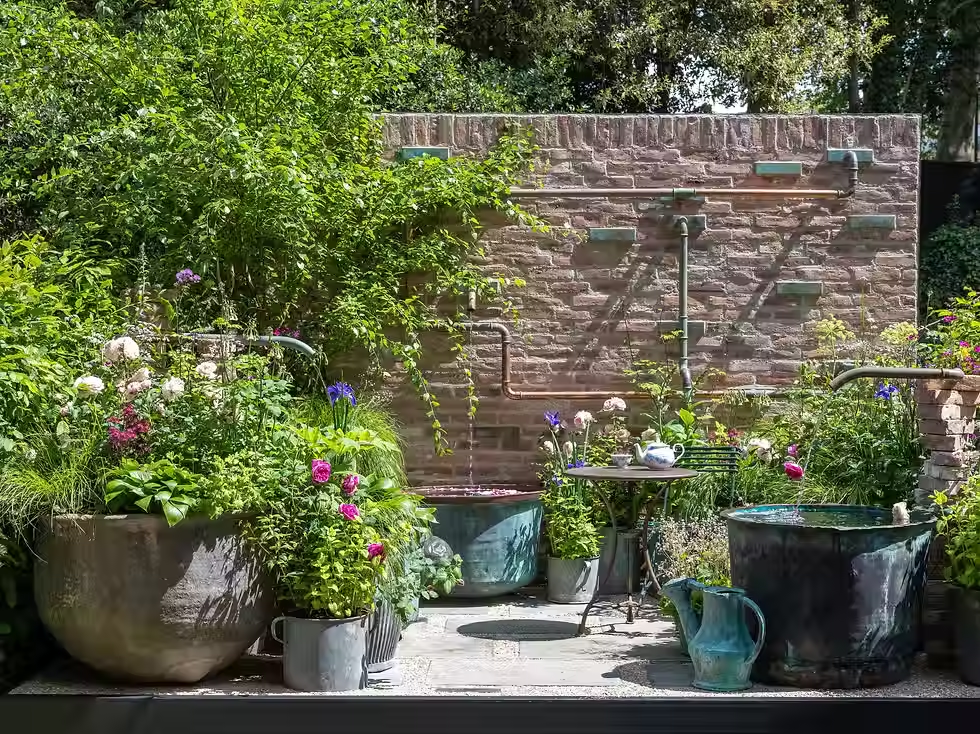
The Campaign to Protect Rural England garden is not alone in this direction. Chelsea 2026 shows a broad turn toward gardens designed as retreats, as spaces for solitude and restoration rather than display.
The Kiliki and Co "A Seed in Time" garden places naturalistic planting at its centre, with a colour palette of pale purples, oranges, and deep reds evoking wildflowers found at field margins. The RHS and The King's Foundation Curious Garden takes a sustainable and productive approach, integrating edible plants with ecological design. Kazuyuki Ishihara's Tokonoma Garden draws from Japanese Zen traditions to create a space crafted specifically for contemplation and the appreciation of beauty, one of four large show gardens this year drawing from Japanese design principles.
Andrew Duff, chairman of the Society of Garden and Landscape Designers, noted at this year's show: "A return to naturalistic layouts is evident, with designers demonstrating how rural landscapes can be evoked even in urban settings."
The through-line across all of these gardens is the same: the garden as emotional medicine rather than horticultural performance.
The Climate Dimension

The shift toward naturalistic planting is not only aesthetic or emotional. It is practical in a way that Chelsea is not usually required to acknowledge.
Climate-resilient planting was a significant second theme at the 2026 show. The Project Giving Back Garden offered what its designers described as a glimpse of what UK gardens may look like in the near future, featuring drought-tolerant plants suited to a warmer southern European climate. Common thyme, Mediterranean herbs, and trees adapted to dry conditions sat alongside plants chosen specifically for their capacity to support pollinators through seasonal stress.
Helen Bostock, RHS senior wildlife specialist, confirmed that in 2026, wildlife gardening has become a prerequisite of the major show gardens, being sensitively wrapped into the design even where it is not the primary narrative. Plants are now specifically chosen in support of certain animals and insects, she noted, and more than half of British gardeners, 52%, have already changed the way they garden to support local wildlife.
The show garden has always been aspirational. What Chelsea 2026 suggests is that the new aspiration is resilience, ecological generosity, and a willingness to let the garden be something less than perfect in exchange for something more than decorative.
What This Means for How We Think About Outdoor Space

The garden has always been a cultural document. The formal garden of the seventeenth century said something about the relationship between humans and nature: that nature was something to be organised and controlled. The Victorian cottage garden said something else: that abundance and sentiment had their own kind of order. The stripped-back modernist garden of the 2000s and 2010s, all clipped box and pale gravel, said that the garden should be as easy to maintain as it was to photograph.
The Chelsea 2026 garden is saying something different. That the space outside your door does not need to be a room, exactly. That it can be a different kind of place entirely: somewhere between inside and outside, between tended and wild, between what you have made and what has arrived of its own accord.
This connects to the biophilic design conversation, to the nonnamaxxing thread, to the broader 2026 appetite for spaces that acknowledge ecological reality rather than decorating over it. The wild garden is not an absence of design. It is a different kind of intention: one that makes room for what is not entirely under your control, and finds that this makes the space more beautiful, not less.
The drawing room, for centuries, was the most considered room in the house. The space that expressed who you were to the people you invited in. Chelsea 2026 is suggesting that the garden has taken that position. And that what it now expresses, in the best examples on the showground this week, is something the drawing room was never quite able to: the willingness to let something live.