Why the Monsoon Is India's Most Romantic Season: The Mumbai Monsoon Girl

The monsoon has arrived in Mumbai. The asphalt is wet. The air smells of petrichor and possibility. And somewhere between the waterlogged streets and the chai going cold on a windowsill, a particular kind of beauty is happening that no other season and no other city can replicate.
By Maheshwari Vickyraj

The southwest monsoon made its onset over Mumbai two days ahead of the normal schedule this year. The IMD confirmed it and the city felt it before the announcement came. That particular quality of light in the afternoon, grey and diffuse and somehow more beautiful than clear skies. The smell arriving before the rain does and sound of it on a tin roof, on the sea, on the leaves of a tree that has been waiting since March.
Mumbai has many seasons, but only one that belongs to it completely. The monsoon is not something the city endures, it's something the city becomes.
What Is the Mumbai Monsoon Aesthetic?

The Mumbai monsoon aesthetic is not a fashion trend imported from a runway or a Pinterest mood board. It is something older and more specific than that. It is the visual and sensory language of a city during its most emotionally charged season, translated into how people dress, move, eat, and feel between June and September.
The palette is immediate and unmistakeable. Wet asphalt grey, turmeric yellow and moss green. The colours of the city in the rain: the dark roads reflecting neon signs, the yellow of a vada pav stall under a tarpaulin, the green of everything that has been waiting to grow. These are not chosen colours. They are observed ones.
The textures are equally specific. Cotton kurtas that dry quickly and feel clean against skin dampened by humidity. Oxidised silver jewellery that weathers the rain without complaint. Kolhapuri chappals that have seen monsoons before. The aesthetic does not fight the season. It accommodates it with a particular kind of grace.
Why the Monsoon Has Always Been Romantic

Indian poetry often celebrates the beauty and romance of the monsoon. Kalidasa's Meghaduta, a renowned Sanskrit poem, tells the story of a lovelorn yaksha who sends a message to his distant beloved via a monsoon cloud, with the description of the monsoon landscape evoking the season's emotional and sensory experiences.
In Indian classical music, monsoon ragas such as Megh Malhar and Desh are traditionally performed during the rainy season and are believed to evoke the monsoon mood. Rabindranath Tagore, in his collection Gitanjali, wrote about the joy and rejuvenation that accompany the rains, describing the monsoon not merely as a natural phenomenon but as a profound experience that awakens the senses and the soul.
In Indian culture, the monsoon season is often romanticised in films and music, further fuelling the association of rain with romance and love. Romanticising the monsoon involves viewing rainy days with fondness and positive emotions, often associating them with feelings of cosiness, peace, and nostalgia, stemming from the soothing sound of rain, the pleasant smell of petrichor, and the visual appeal of a landscape washed clean.
The monsoon is the season that Indian literature, music, and cinema have always understood best. It is the season when something is possible that is not possible in any other weather.
The Cinematic Quality of the Mumbai Monsoon

There is a particular kind of Mumbai film that could only have been made in the rain. Wake Up Sid, with its terrace scenes and its particular shade of longing. Barfi, with its Darjeeling monsoon used as a backdrop for something achingly tender. Sanjay Leela Bhansali's entire visual vocabulary, which borrows the monsoon's capacity for heightened emotion and applies it to every season indiscriminately.
Rains have a special love affair with Mumbai and Bollywood. For some, it evokes romance and nostalgia, while for others it brings back memories of waterlogged streets and daily commute problems. Bollywood directors have traditionally had a soft corner for rain. There is something in the rain that makes us nostalgic, that makes us think of childhood, college, years gone by.
The monsoon Mumbai aesthetic is cinematic not because it is trying to look like a film but because the conditions it creates, the quality of light, the heightened sensory environment, the enforced slowness of a city under heavy rain, produce exactly the kind of emotional intensity that cinema has always tried to manufacture artificially.
For the uninitiated, the first encounter with Mumbai's monsoon can feel overwhelming, evoking feelings of awe, frustration and unexpected joy, along with unbridled nostalgia.
As one writer described it to Tweak India: "As a writer, the first few days of the Mumbai monsoon felt incredibly romantic, seemingly cleansing the streets."
The Mumbai Monsoon Girl: How She Dresses

The Mumbai monsoon girl is not dressing for a photoshoot. She is dressing for the 8.52 local from Churchgate with a raincoat that actually works and earrings she does not mind getting wet.
But within those practical constraints, there is an aesthetic that is entirely her own.
Cotton kurtas in monsoon tones. Moss green, indigo. The deep turmeric yellow of a marigold garland after rain. The kurta is the correct garment for the Mumbai monsoon because it moves with the body, dries without complaint, and carries the cultural weight of the city's textile history in every thread. Worn with straight-cut trousers or a simple salwar, it is both practical and quietly beautiful.
Oxidised silver. The Mumbai monsoon girl's jewellery is not precious in the monetary sense. It is precious in the sense of meaning something. Oxidised silver earrings, a stackable ring, a single necklace with a pendant that carries a story. These are pieces that improve with exposure to the elements rather than suffering from them.
Kolhapuri chappals or simple leather sandals. The monsoon is not shoe-friendly, but the right sandal survives it with character. Kolhapuri chappals have been doing this for centuries. They are the footwear equivalent of the oxidised silver earring: they carry their history visibly and are better for it.
A dupatta worn with intention. The dupatta in the monsoon is a practical object that has been elevated into something else entirely by decades of cinematic association. Worn loose over the shoulder, pulled up against sudden rain, it is the most cinematically charged piece of fabric in the Indian wardrobe.
The Sensory Experience of the Mumbai Monsoon
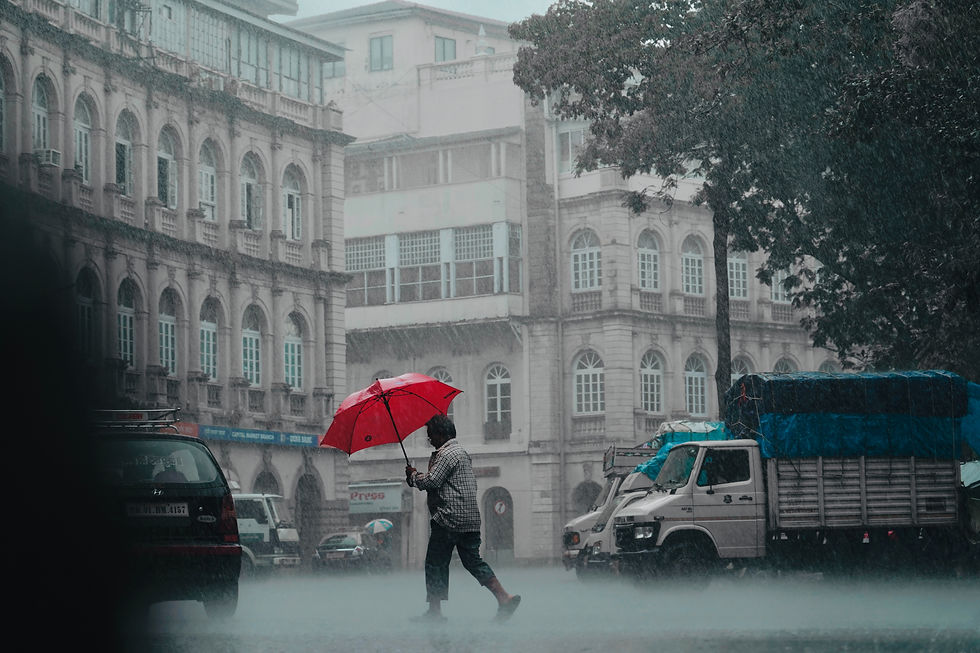
The Mumbai monsoon aesthetic is not only visual. It is the full sensory experience of a particular city in a particular season, and no feature about it is honest without naming what it smells, sounds, and tastes like.
It smells of petrichor on hot asphalt. Of the sea becoming more present. Of chai made in a hurry and consumed before it cools completely. Of the particular combination of rain and street food that is unique to this city and impossible to replicate anywhere else on earth.
It sounds of rain on the corrugated iron roofs of Dharavi. Of the local train arriving through sheets of water. Of an umbrella being shaken out in a building lobby. Of the city, which is never quiet, becoming briefly and improbably so in the minutes just before a heavy shower arrives.
It tastes of vada pav eaten standing at a stall under a tarpaulin. Of bhajiyas made for rain and consumed during it. Of cutting chai that tastes different in this weather than it does in any other, which it genuinely does, and which every Mumbaikar will confirm without hesitation.
What the Monsoon Asks of You

Only once you live through it can you truly understand why there is nothing quite like Mumbai ki baarish.
The monsoon asks for a particular quality of surrender. Not to inconvenience, though there is inconvenience. But to the city as it actually is during this season: loud, wet, occasionally impossible, and more beautiful than it has any right to be given all of the above.
The Mumbai monsoon aesthetic is, at its deepest level, an aesthetic of acceptance. Of dressing for where you actually are rather than where you wish you were. Of finding the turmeric yellow kurta and the oxidised earring and the Kolhapuri chappal and deciding that this, the rain on your skin and the smell of the street and the chai going cold on the windowsill, is enough.
More than enough. It is the whole thing.
This aesthetic does not speak to longing for Europe or for somewhere else. It speaks to longing for here. For this city. For this season. For the particular combination of difficulty and beauty that only Mumbai in the monsoon has ever managed to produce.
It is, of all the girl aesthetics in circulation this summer, the only one that could not exist anywhere else on earth.
From the Sound Archive
Because every aesthetic has a soundtrack.
Some cities become more themselves when it rains. Pavements shimmer beneath streetlights, café windows fog with conversation, jasmine mingles with petrichor, and every taxi ride feels like the opening scene of a film.
The Mumbai Monsoon Girl is the listening companion to this feature, a collection of indie pop, soft jazz, Bollywood classics, dream-pop, and rain-soaked melodies that capture the romance of getting caught in the downpour instead of running from it.
Press play, pour yourself a cup of chai, watch the rain gather on the windowsill, and let the monsoon unfold at its own unhurried pace.

