What Paris Haute Couture AW26/27 Was Really Saying: The Season India Arrived, and Science Took Over

Paris Haute Couture AW26/27 ran from 6 to 9 July 2026 under a heatwave and enormous cultural expectation. Here is what appeared again and again across the week, and what it reveals about where fashion's most rarefied conversation is heading.
By Maheshwari Vickyraj
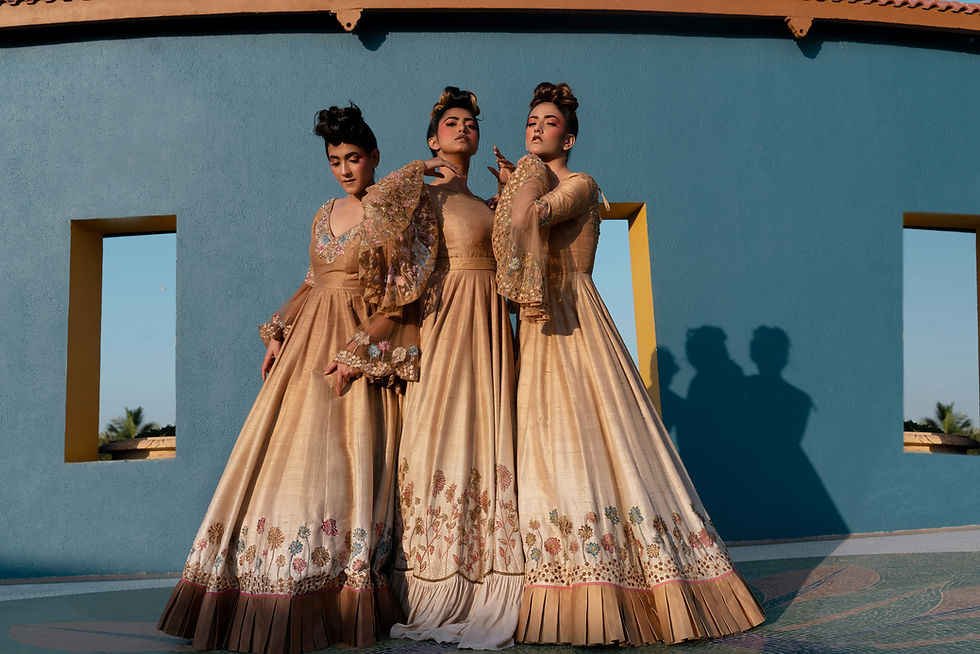
The context for Paris Haute Couture AW26/27 was unusual even by the standards of a week that routinely stage-manages its own mythology. Jonathan Anderson had just dressed Taylor Swift and Travis Kelce for their wedding, generating a reported $15 million in media impact value for Dior over the Fourth of July weekend, which meant the city arrived at the shows already at an unusual pitch of anticipation. France was still in the World Cup while paris was baking under 30 degrees. And for the first time in the history of the official FHCM calendar, two Indian designers were showing in the same couture week.
Rather than reviewing each collection individually, we looked across the four days and asked what kept returning. Not what any single house decided, but what the season as a whole appeared to be working out simultaneously across ateliers that share very little except the address.
Five things kept showing up.
India Arrived at the Top Table, and It Was Not a Guest Appearance

The most significant story of Paris Haute Couture AW26/27 is not a trend. It is a structural shift, and it is worth naming before anything else.
Rahul Mishra has been on the official FHCM calendar since 2020, when he became the first Indian designer invited to Paris Couture. Manish Malhotra debuted on the official calendar on 8 July 2026, becoming the fourth Indian designer to hold that distinction, joining Rahul Mishra, Gaurav Gupta, and Vaishali S. on the official FHCM calendar. The two appeared in the same week, which has not happened before, and together they represented something that the broader fashion press did not quite treat as the central story of the season even though it arguably was.
Mishra's collection review confirms that Mishra staged his most personally India-rooted collection to date, titled Devi: The Eternal Muse, under the Gothic vaults of the Collège des Bernardins. He drew directly from the Ajanta Caves, a twelfth-century stone dancer from Karnataka, and the Tarakeshwara Temple, translating the visual language of ancient temple sculpture into contemporary couture rather than merely referencing it. Zardozi and dabka techniques were used alongside crystals and bugle beads to create the trompe l'oeil texture of basalt, soapstone, and bronze, while the garments themselves remained featherweight, which is precisely the contradiction at the heart of couture's finest moments.
Calling it "the most India-inspired collection" he has ever done, Mishra described the creative process as "almost like time travel."
Isha Ambani and Cardi B both sat in the front row, with Cardi walking out in a custom ivory Mishra look inspired by the twelfth-century sculpture of Mohini at the Chennakeshava Temple in Belur.
Malhotra's debut was altogether more intimate. His collection, titled Maa, was built around the loss of his mother, Sudarshan Malhotra, who passed away on 19 March 2026 at the age of 94. He received his place on the official calendar three months after her death, and the collection progressed through four chapters, Cocoon, Bond, Becoming, and Abundance, mapping the emotional architecture of maternal love through the structural language of French haute couture. The palette drew from the colours of the sarees his mother wore in the 1970s. Zardozi, resham, sequins, pearls, and precious embellishments moved through velvets, silks, and brocades. The front row at Pavillon Cambon included Anna Wintour, Isha Ambani, Karan Johar, and Fan Bingbing.
His show notes read: "Her passing has transformed memory into reflection, and reflection into creation."
The wearable version of what both designers demonstrated is less about specific garments than about what they proved: that the vocabulary of Indian craft, which has been embedded in global fashion through influence for decades, can now occupy the highest formal position in that conversation on its own terms.
Science Became a Material, Not a Metaphor

Across the week, several houses pushed the definition of what couture can be made from into territory that would have read as conceptual art not long ago, and at Iris van Herpen it became something closer to physics.
Her collection, Sonic Starquakes, incorporated plasma into a garment for the first time in couture history. The standout piece, named Helix Nebula, was built from a crescent moon glass tube filled with plasma and covered in 8,000 hand-blown glass spheres bonded to nearly invisible tulle, reacting to the wearer's own electromagnetic field and glowing red as charged particles moved through the glass in response to the body's conductivity. A second look, Fractal Universe, developed with scientist Dale Sulak, was electrically charged to create branching Lichtenberg figures, fractal lightning-like patterns that etched themselves across the garment's surface, which van Herpen incorporated as the collection's most poetic accident. "
"We have shaped haute couture from solids, liquids, living matter and even gas," she said. "This is the first time we have worked with the fourth state of matter, plasma."
Schiaparelli moved in a parallel direction from a different starting point. Daniel Roseberry's collection, titled The Call of the Void, emerged from what he described in his show notes as a period of creative paralysis after last season's success, and resolved itself by abandoning the conventional material vocabulary of couture entirely. Silks, satins, and wool were replaced with latex, silicone, dried flowers, fish scales, and sculpted sheets of baked paint. The result was surrealism distilled into something more restrained than the house usually offers, with sculpted bustiers that morphed into cocktail silhouettes and phantasmagorical jumpsuits with tubular tentacles, all executed with the precision that haute couture demands of even its most experimental proposals.
Across the season, a wearable version of this direction is harder to identify than in most seasons, because the specific materials are by definition beyond the reach of any wardrobe. However, what it suggests for the broader fashion conversation is the continued dissolution of the boundary between atelier and laboratory, between making and experimenting, that is likely to reach ready-to-wear within a season or two.
Craft as Archive, Not as Decoration

Across both the established houses and the season's two most significant debuts, craft appeared not as decoration but as historical evidence, as a way of making visible what has been accumulated over time and would otherwise be invisible.
At Dior, Jonathan Anderson took the sculptures of American artist Lynda Benglis as his starting point, translating her poured and knotted forms directly into fabric, including a silver lamé dress draped into a bow echoing Benglis's pleated metallic Goliath sculpture. Crucially, Benglis's own connection to India shaped the collection's materials: chintz sourced from an eighteenth-century Indian textile dealer appeared on bags and in embroidery, and jewellery handmade in Jaipur featuring carved green onyx and mother of pearl ran through the accessories.
"The collection is about looking at materiality and form from another angle," Anderson told journalists backstage. "Looking at the abstraction in material, ultimately." The season's buzziest look, however, remained the wedding dress with which he closed the show, embroidered with fabric fern stems and leaves, which Anderson confirmed he had designed for Taylor Swift, describing the honour of dressing her for the occasion.
At Armani Privé, Silvana Armani, designing her first season following the passing of Giorgio Armani last year, held to the classicism that defined the house while threading experimentation through a palette of hunter green, burgundy, burnt amaranth, and black. A series of glistening masculine jackets in dark velvet drew an extraordinary front row, including Cate Blanchett, Rosamund Pike, and Tilda Swinton, all in black tuxedo looks that confirmed the house's sustained authority in exactly the register it has always occupied.
At Chanel, Matthieu Blazy's second couture collection built a modern fairy tale from Gabrielle Chanel's personal library, with a century-old leatherbound book of fairy tales carried by the first model onto the runway as both prop and thesis. Beanstalk heels, climbing vine embroidery, and magpie-treasure jewellery moved through the collection, with Blazy positioning couture itself as a form of storytelling where every garment conceals a quiet narrative thread.
Debuts That Held Their Own

Two debuts this season arrived with genuine weight rather than the novelty that often characterises a first appearance on a prestigious calendar.
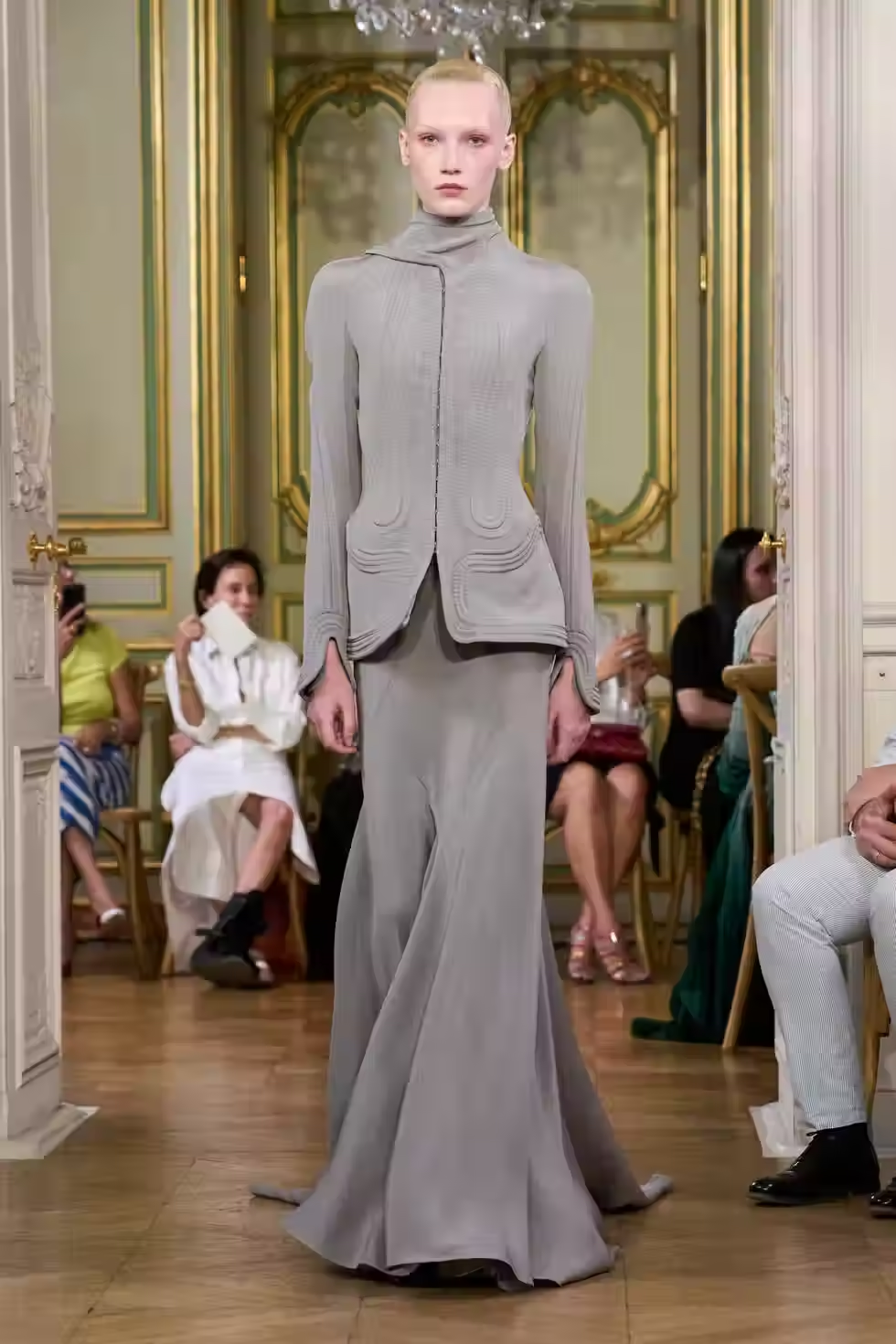
Standing Ground, the brand of County Clare-born Irish designer Michael Stewart, whose debut couture collection was presented inside the Irish Embassy. Stewart graduated from the Royal College of Art in 2017, spent years navigating the industry before leaving it, relaunched with the support of Fashion East in 2022, won the Savoir-Faire prize at the 2024 LVMH Prize, and arrived in Paris with the accumulated seriousness of someone who has been working toward this exact moment for a long time.

His collection offered gowns of almost spiritual restraint: long, pure, mono-colour robes finished with hidden beading and tubes, draped and ruched with a precision that had nothing performative about it. The collection closed with Kristen McMenamy in a white wedding dress in abstract handmade Carrickmacross lace, a specifically Irish textile tradition that has not been seen on the Paris couture runway before.
"I feel very welcomed in Paris and I really appreciate that," Stewart said backstage. His debut was described by Elite Traveler as "a highly accomplished inauguration," and the Irish Embassy setting, across the road from the Champs-Élysées, gave the collection a geographical specificity that reinforced rather than distracted from the clothes.
Together with Malhotra, Stewart's debut confirmed that the couture calendar is expanding its definition of which ateliers and which craft traditions belong at its centre. That expansion is not yet complete, however it is clearly under way.
The Body as Celebration, Not Constraint

Across the season, a recurring attitude appeared in how houses approached the relationship between garment and body, one that leaned toward liberation rather than architecture, toward revealing rather than concealing, even when the silhouette was at its most constructed.
Rahul Mishra named it directly.
"There was no idea of covering the beauty of the body," he told WWD when describing the temple sculptures that inspired his collection. "This is all about celebrating the body." His draping, inspired by the Bharatanatyam dance tradition's central pleat, the thavani, reappeared as beaded designs around the hips and as long, gossamer skirts that moved with the wearer rather than independent of her.
The same instinct appeared in very different forms elsewhere. At Schiaparelli, Roseberry's latex and silicone pieces revealed the body through the specificity of their molding rather than through exposure while Chanel, Blazy's fairy-tale silhouettes moved with the body rather than holding a shape in opposition to it. And at Dior, Anderson's pleated and draped pieces in translucent fabrics placed the body's own movement at the centre of the design, with the Benglis influence insisting on organic form over imposed architecture.
Even Iris van Herpen's most extreme constructions, the glass sphere dress, the plasma-filled forms, were built around the wearer's magnetic field and body heat as active ingredients in the garment's behaviour rather than as variables to be controlled. The body, in these pieces, is not a stand for the clothes but the reason that clothes exist.
What the Season Was Working Toward

Paris Haute Couture AW26/27 was not a week with a single dominant aesthetic direction, which is perhaps the most honest thing that can be said about it. What it had instead was a set of serious proposals arriving simultaneously from designers who share very little except the seriousness with which they approach what couture can mean.
The plasma dress and the temple-embroidered gown and the fairy-tale beanstalk heel and the Carrickmacross lace wedding dress and the trompe l'oeil stone-effect zardozi are not expressions of the same idea. However, they are all expressions of the same ambition: the conviction that the garment can be the site where science, history, personal grief, cultural inheritance, and the specific intelligence of a particular set of hands all arrive in the same object at the same moment.
That is what couture is for, when it is working. This week, it was working.

