What the Men's SS27 Runways Kept Saying: Five Visual Ideas That Appeared Again and Again in Milan and Paris

We looked across every major men's SS27 show in Milan and Paris and asked one question: what kept showing up? Here is what we found.
By Maheshwari Vickyraj

Fashion month for men's Spring/Summer 2027 ran across two cities, a Europe-wide heatwave that pushed both Milan and Paris to nearly 40 degrees, and dozens of collections from houses spanning Japanese minimalism to Italian heritage tailoring to Parisian conceptualism, with shows rescheduled, venues changed, and paramedics standing by at several events. The clothes, in response to all of it, were lighter than they have been in years.
Rather than reviewing each collection in isolation, we looked across the full season and asked what kept returning. Not what a single designer said, but what the season as a whole seemed to be working out. Five ideas came up again and again, across houses that rarely agree on anything.
The Slim Silhouette Is Back, and This Time It Feels Considered

After several seasons of deliberately oversized, volume-led proportions, the silhouette moved noticeably toward the body across both Milan and Paris, though not tight in the constricted sense of a decade ago. Instead it was precise: fitted through the shoulder and chest, narrowing toward the trouser, clean and legible in a way that felt intentional rather than reactionary.
At Prada, Miuccia Prada and Raf Simons described their SS27 collection as "an exercise in clarity" and "an antidote to complication," with shapes drawing on the jean and jean jacket reimagined in different fabrications, maintaining a controlled silhouette that WWD confirmed as the season's slimmest Prada offering in years.
Saint Laurent, Anthony Vaccarello sent out razor-sharp tailored trousers and slim-cut suits, with t2Online confirming that "skinny silhouettes are officially making a comeback," even though the effect felt precise rather than nostalgic. While at Dior, Jonathan Anderson worked through airy organza and worn denim, yet the underlying silhouette remained consistently lean and close to the body throughout. Michael Rider's widely praised menswear debut for Celine built its entire identity around refined, considered shapes that said the same thing in a quieter register.
What this means is not a return to the restrictive trouser of the early 2010s. It is instead a correction toward proportion and precision, away from clothes that obscure the body and toward clothes that give it clarity.
As WWD buyers noted, "a slimmer silhouette emerged, seen in an extreme version at Prada," however it was the consistency of the direction across houses that made it the season's most significant structural shift.

In terms of the wearable version: swap your current relaxed-fit tailoring for a straight or slightly tapered trouser that finishes cleanly at the ankle, worn with a fitted knit or a simple shirt tucked in. The adjustment is about precision rather than tightness, and the result is a suit returned to its fundamental purpose as a shape that gives the body something to say.
Every House Reached for Something Lighter

Repeatedly throughout both cities, the clothes were made from materials chosen specifically for their lack of weight, with linen, organza, sheer silk, open-weave knits, seersucker, and diaphanous layers appearing across collections that had very little else in common. Even though the record-breaking heatwave provided an obvious context, the lightness had clearly been in development long before temperatures rose, which made it feel like a genuine seasonal direction rather than a reactive adjustment.
At Dries Van Noten, Julian Klausner sent out sheer organza jackets, silk cargo pants, and tabard tops in sunset and sorbet hues, with Wallpaper confirming that "the idea of lightness was at the heart of this latest outing." At Giorgio Armani, Leo Dell'Orco built his Mediterranean Market collection on louche tailoring, open-weave knits, and safari-style jackets, with WWD buyers describing "weightless ultra-fine cloth in cashmere, silk and linen" as the defining material story.
At Dior, Jonathan Anderson worked through "almost transparent fabrics," with fluid suits and chiffon pieces that draped over the body rather than holding a structured shape. Lemaire, which remains a benchmark for considered neutral dressing, continued its language of soft, unlined pieces throughout, while Soshiotsuki, the 2026 LVMH Prize winner showing in Paris for the first time, explored the Japanese salaryman on summer vacation through intentionally loosely structured tailoring.
In fact, WWD buyers confirmed across the board that "everything seemed pretty light this season, a lot of linen, seersucker, organza, mesh, soft wool," with linen blends emerging as the dominant fabric story across both the Milan showroom season and the runway itself. The practical version of this direction is simply to reconsider what your tailoring is made from, since a linen blazer worn over a cotton shirt will move and feel entirely differently from a structured wool one in the same silhouette. Choose the lighter option wherever the shape allows it, and the season translates directly.
The Colour Story Was Warm, Faded, and Looked Better for It
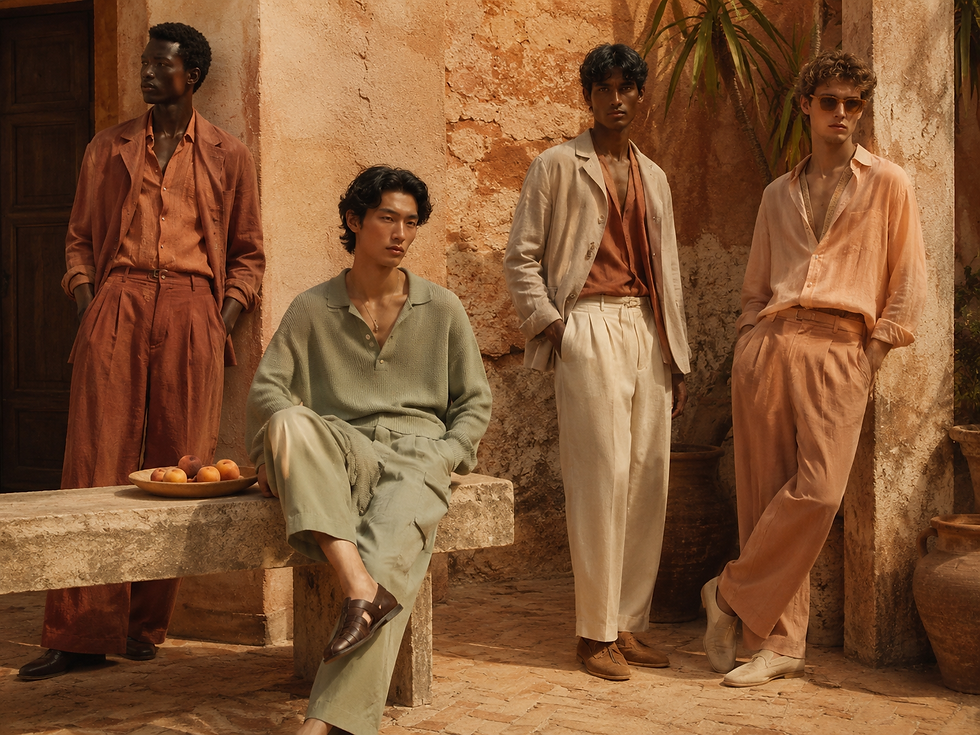
Across both cities, a specific quality of colour appeared repeatedly: warm, desaturated, and faded, though not muted in the cold Scandinavian sense of greige or charcoal. Instead the palette was sun-touched, running through terracotta, rust, brick, dusty sage, apricot, sand, ivory, and vanilla, as though each piece had been left in strong light and improved because of it. Even houses with very different aesthetic identities arrived at something similar in this regard.

At Giorgio Armani, the collection built on "earthy desert tones and blues evocative of sea and sky," confirmed by both Wallpaper and WWD, while Brunello Cucinelli worked through sun-faded tones alongside tie-dyed versions of the same dusty palette. WWD buyers confirmed that "sun-faded and dusty tones were recurrent, and fetchingly developed at Giorgio Armani and also in tie-dyed versions at Brunello Cucinelli." At Dolce and Gabbana, which staged what Wallpaper described as a Sicilian vacation, the palette was dominated by warm coastal tones throughout, while Acne Studios sent out faded pastel sweaters and washed denim in stone-washed tones specifically chosen for their vintage quality.

The appeal of the washed, faded palette connects to a broader appetite visible across 2026 for objects and clothes that carry evidence of time, as though the garment has a history rather than a launch date.
As Beppe Nugnes, president of Nugnes 1920, told WWD, "many designers are returning to focus on the product, fit and wardrobe construction," and the faded palette is part of that return, a colour story built on permanence rather than novelty.
To bring it into an everyday wardrobe, look for trousers, shirts, and knitwear in terracotta, rust, warm sand, or dusty sage, worn with ivory or vanilla separates so the palette reads as complete rather than coordinated.
Good Tailoring, Worn as Though It Did Not Know It Was

Alongside the lean silhouette, a recurring styling idea ran across both cities: tailoring that has been deliberately deconstructed, unlined, left open, or placed in combination with something unexpected, whether a jacket worn without a shirt, a suit paired with shorts, or a formal piece treated as though it does not know it is formal. Even though the starting point in each case was classic construction, the result consistently looked as though convention had been set aside in favour of something more personal.
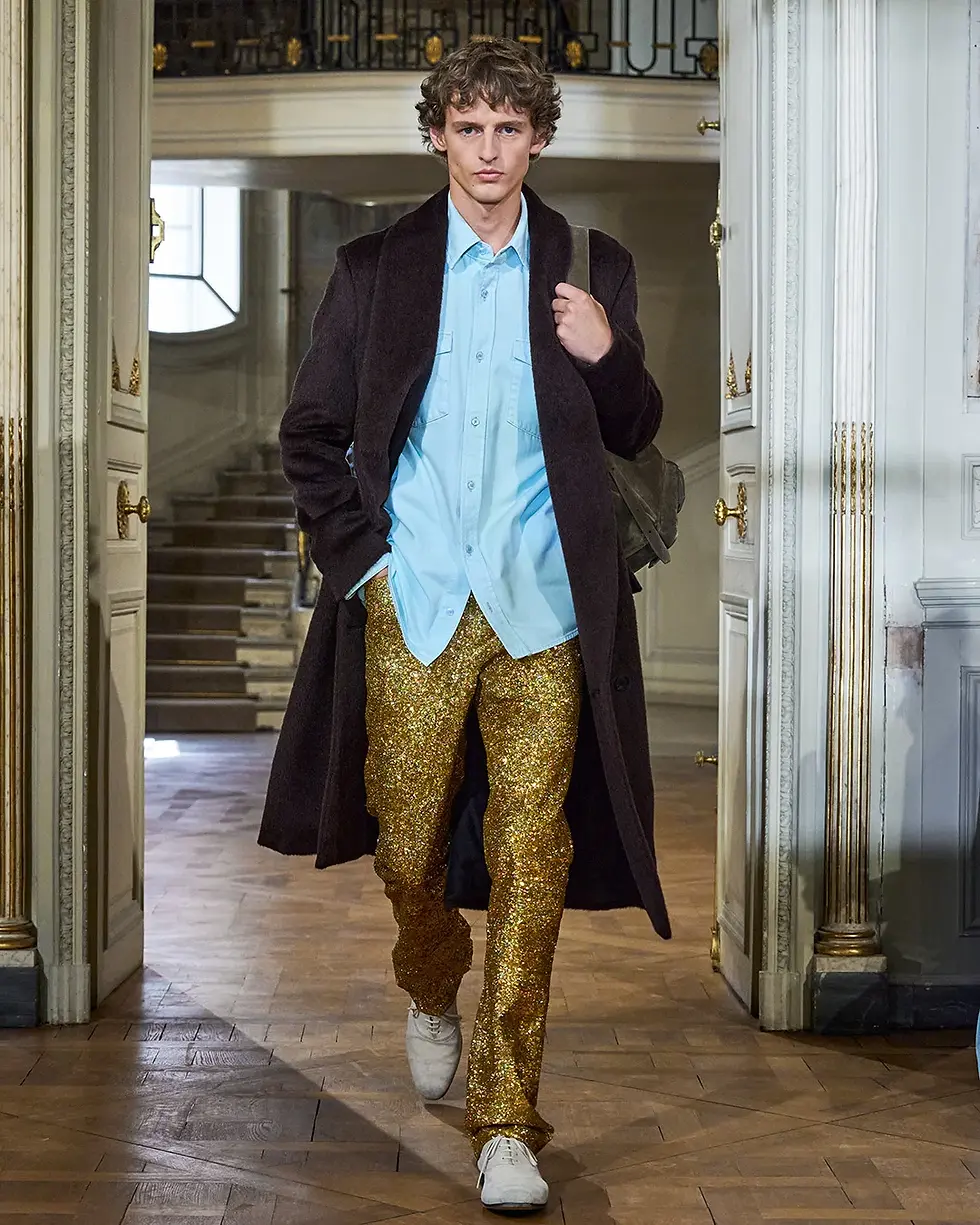
At Dior, Jonathan Anderson worked through "things left undone, with tailoring unlined and fabric draping over the body," while at Paul Smith, the collection drew on a photograph of his grandfather on holiday with suit trousers rolled up to paddle in the water, producing undone tailoring that felt entirely natural rather than conceptual. At Ami Paris, NSS Magazine confirmed that "traditional tailoring met deconstruction," with pinstriped shirts becoming skirts and silk micro shorts paired with workwear jackets, while at Thom Browne, whose Milan debut was set among 400 seersucker roses, the signature striped tailoring was updated with kilts and Bermuda trousers.
At Soshiotsuki, the approach was through "asymmetry, unfinished details and loosely fastened garments revealing the layers beneath."

Victor Poulsen, buyer for men's luxury at Printemps, told WWD that the season "reflected a growing desire for authenticity and longevity," with many brands "focused on refining their identity rather than chasing novelty for its own sake."
The deconstructed jacket is one expression of that authenticity, a tailored piece worn with enough ease that it no longer looks like an effort. The simplest wearable version is to stop tucking in, wear the blazer open over a simple t-shirt and straight-leg trouser, or try the tailored jacket with shorts rather than trousers. The formal piece does not need to be worn formally, and the quality of the fabric earns its place without the support of convention.
Embellishment Arrived in Menswear, Though Nobody Overplayed It

Embellishment ran through the season in a way that felt specific and considered rather than decorative or excessive, with embroidery, beading, clear paillettes, and floral detail present at multiple houses, though always as a precise accent rather than an overall statement. Even though the instinct in menswear has historically been to treat any ornamentation as exceptional, several houses proposed it this season as simply part of a well-made piece.

At Thom Browne, bee and floral motifs were embroidered across outerwear and accessories, described by Monocle as adding "a sense of romance and whimsy often missing from most menswear presentations," while at Dries Van Noten, Julian Klausner used clear paillettes, floral embroidery, and feather headpieces to add richness without weight, with Wallpaper confirming the embellishment as one of the collection's defining signatures.

At Saint Laurent, three-button jackets were adorned with gold jewel embellishments, confirming the detail as a deliberate Vaccarello proposition rather than a finishing touch. While Givenchy, Sarah Burton's debut menswear collection brought her couture sensibility to the category, with a small ruby cufflink set in gold described by Notion as quietly stealing the show from more prominent silhouette choices. At Meryll Rogge's debut, presented inside the Belgian ambassador's residence, floral prints and considered ornamentation were central to the collection's identity throughout.

What this means is not that menswear is becoming ornate. It is instead that the beaded detail and the embroidered motif are increasingly being proposed as evidence of craft rather than occasion, which aligns with what Simon Longland, director of buying fashion at Harrods, described to WWD as "a noticeable emphasis on craftsmanship, quality and wearable innovation."
In practice, one embroidered or embellished item is the complete wardrobe statement. A floral-embroidered jacket over a plain shirt and simple trouser does everything it needs to do, and the season's most effective versions were almost always single-item propositions, which is also the most wearable interpretation.
What the Season Was Actually Working Toward
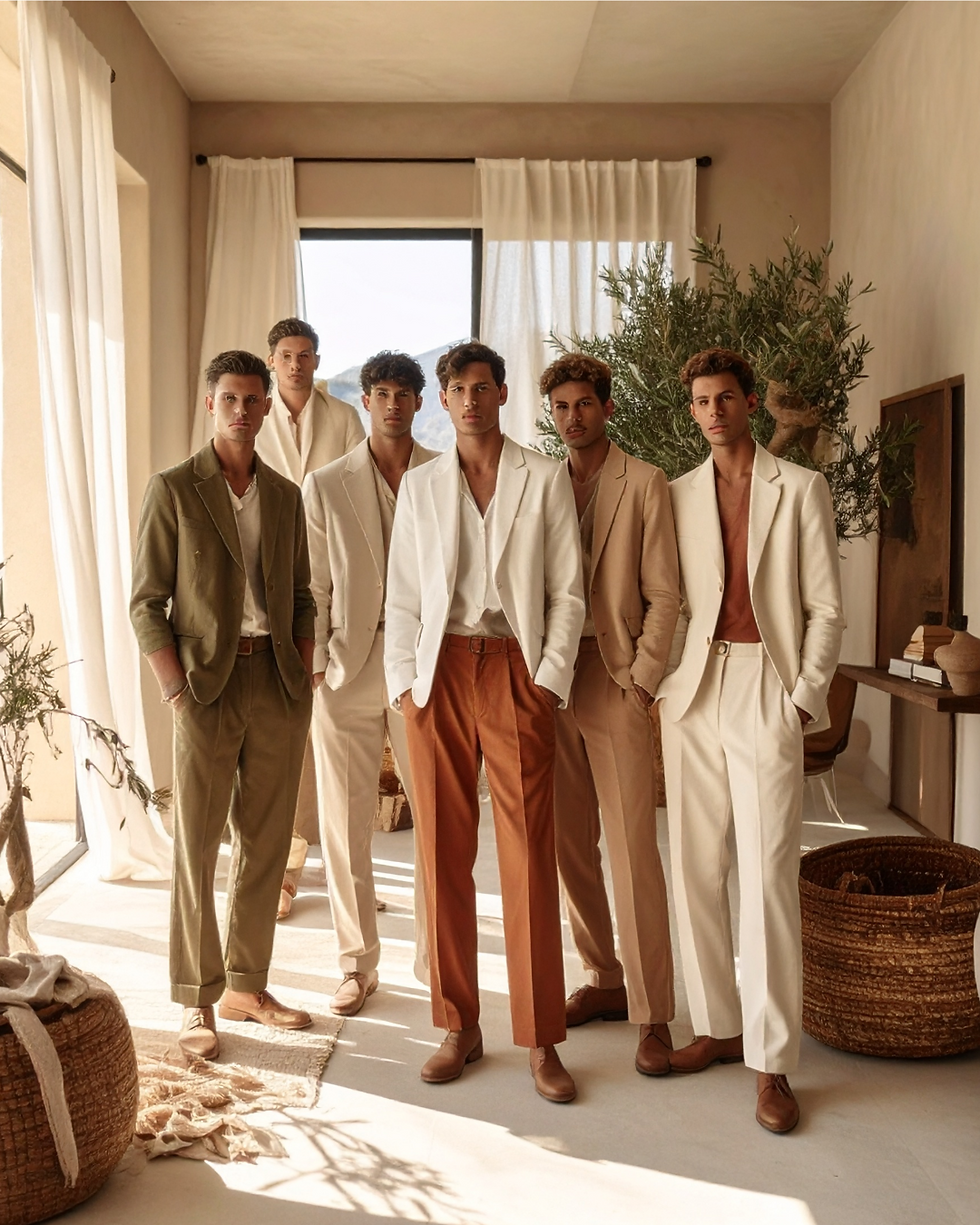
Across Milan and Paris, the men's SS27 season produced something that feels less like a set of trends and more like a collective recalibration, with Prada calling it "an exercise in clarity," Giorgio Armani framing it as "Mediterranean Market," Paul Smith finding it in a photograph of his grandfather paddling in a suit, and Julian Klausner expressing it through diaphanous layers in sunset tones at Dries Van Noten.

What kept returning, beneath all of these different expressions, was a quality of ease: clothes made lighter, silhouettes made cleaner, palettes made warmer and less anxious, tailoring allowed to relax without losing its identity. Not casual in the careless sense, but considered in the unhurried one. That distinction, between clothes that look effortless because they were not thought about and clothes that look effortless because they were thought about very carefully, is the season's most useful lesson for anyone trying to translate it into an actual wardrobe.