Why Everyone Stops to Fish on Istanbul's Bridges...
In one of the world’s busiest cities, hundreds of people voluntarily stand still for hours. On Istanbul’s Galata Bridge, fishing is less about what comes out of the water than what happens inside the people waiting beside it.
By Sarah Haider

It is seven in the morning and the Galata Bridge is already lined with rods, dozens of them extending over the railing at even intervals with lines dropping into the Golden Horn below, their owners standing in the particular stillness that fishing produces in a person: alert, patient, entirely elsewhere from the city doing its business around them. The retirees arrived before dawn and claimed their positions the way they do every morning, the same railing, the same view, the same unhurried relationship with the water that they have been developing for longer than most tourists have known Istanbul existed.
By noon the line will have changed, though not the feeling of it. Office workers on lunch breaks will have appeared alongside the retirees, standing over the water with a rod for reasons they might not be able to fully articulate, and teenagers with plastic buckets and borrowed equipment will occupy the gaps in between, while a vendor moves through the crowd selling bait, tea, and spare hooks with the efficiency of someone who has mapped this exact crowd for years. A gull watches from the railing with the focused attention of someone who has been doing this longer than any of them, and considerably more successfully.
This is Istanbul on an ordinary Tuesday, and it is one of the most quietly extraordinary things you will see in any city on earth.
The Bridge Between Two Worlds

The Galata Bridge connects Eminönü on the historic peninsula with Karaköy on the modern European side, carrying trams, pedestrians, and the constant negotiation of a city that has always existed in two registers simultaneously. The dome of the Süleymaniye Mosque sits above it in the middle distance in the way that Istanbul's grandest monuments tend to sit: casually, as though they have not noticed they are magnificent, which is perhaps the most specifically Turkish quality in a city full of them.

Walk across the bridge and you are technically crossing a waterway, however you are also crossing something considerably harder to name. On one side, the spice bazaar, the mosques, the layered Ottoman city where the streets narrow and the light changes and the twentieth century loosens its grip. On the other, galleries, coffee shops, the steep streets climbing toward Galata Tower and the neighbourhood of Karaköy, which in the last decade has become one of the most genuinely interesting places to eat and drink in Europe. Istanbul has always been a city of two sides, and the bridge has always been the place where they meet, mingle, and negotiate, whereas the fishermen, who occupy the railings on both sides with total indifference to the geopolitical implications of their position, have been doing this negotiation longer than anyone.

Orhan Pamuk, who has spent his entire literary career trying to explain what this city does to the people who live inside it, described the Bosphorus as something you have to travel along, by ferry or rowboat, to understand: the city seen house by house, neighbourhood by neighbourhood, and also from afar as a silhouette, an ever-mutating mirage. The fishermen have found a different method, however, and in fact a more effective one. They stand still and let the city move around them.
What They Are Actually Catching

The Golden Horn was, for most of the twentieth century, too polluted to support much life, however a sustained cleanup operation from the 1980s onward changed that entirely, restoring fish populations that urban pollution had decimated and returning the waterway to something closer to what it would have been when the city was first built around it. The fishermen now casting their lines are pulling up cinekop, bluefish, and palamut, Atlantic bonito, from water clean enough to sustain real populations of both, and the catch is genuine even if the pace is deliberately unhurried.
Most of the fishermen have been coming to the same spot for over a decade, learning the moods of the water the way you learn the habits of a neighbourhood, and on a good morning the buckets fill in a way that justifies the early start. On a slow afternoon, nothing bites and nobody seems particularly troubled by this, because that is part of the point, and arguably the larger part. The rod is in the water, and what happens next is not entirely up to you, which for a city that otherwise runs at considerable intensity is a meaningful philosophical position to occupy.
The Balık Ekmek: Istanbul's Best Meal, Served From a Boat

Walk to the Eminönü end of the bridge and follow your nose, because the smell arrives before the boats do: grilled mackerel, charcoal, salt water, the particular warmth of bread that has just come out of something hot. The balık ekmek boats are moored at the waterfront, ornately decorated and rocking gently with the traffic on the Horn, their grills going constantly regardless of the time of day or the weather, which in Istanbul can change its mind several times between breakfast and lunch.
The balık ekmek, which translates as fish bread, is mackerel grilled on the boat and tucked into crusty bread with onion, lettuce, and a squeeze of lemon, and even though the description makes it sound straightforward, the combination of the setting, the freshness, and the fact that you are eating it on a small stool at the water's edge while a ferry departs and a gull reconsiders its options produces something that no restaurant in the city has ever quite managed to replicate. The bread is slightly too warm to hold comfortably, and you eat it anyway.
Food writer Rebecca Seal, in her book Istanbul: Recipes from the Heart of Turkey, captured it with the directness the place deserves: food is at the centre of everything here, whether in upmarket areas like old money Nişantaşı, where you are perhaps more likely to catch a whiff of truffles than charcoal-grilled meats, or on the waterfront at Galata Bridge buying a fish sandwich and beer taken from a bucket of ice.
The fish sandwich does not need a restaurant, a reservation, or a dress code, whereas it does need a boat, a grill, and the Golden Horn on a Tuesday morning, all of which are reliably available.
Under the Bridge: A Different City Entirely

The lower level of the is its own world, slow and dim and waterfront in a way that the upper level, with its trams and pedestrians and the constant business of a city crossing itself, gives no indication of. Seafood restaurants line both sides, their tables close enough to the water that ferries pass within metres of the window, and in the early evening the light through the glass does something to a glass of raki that is difficult to describe without sounding as though you are overselling it, except that everyone who has sat there at that hour will confirm that you are not.
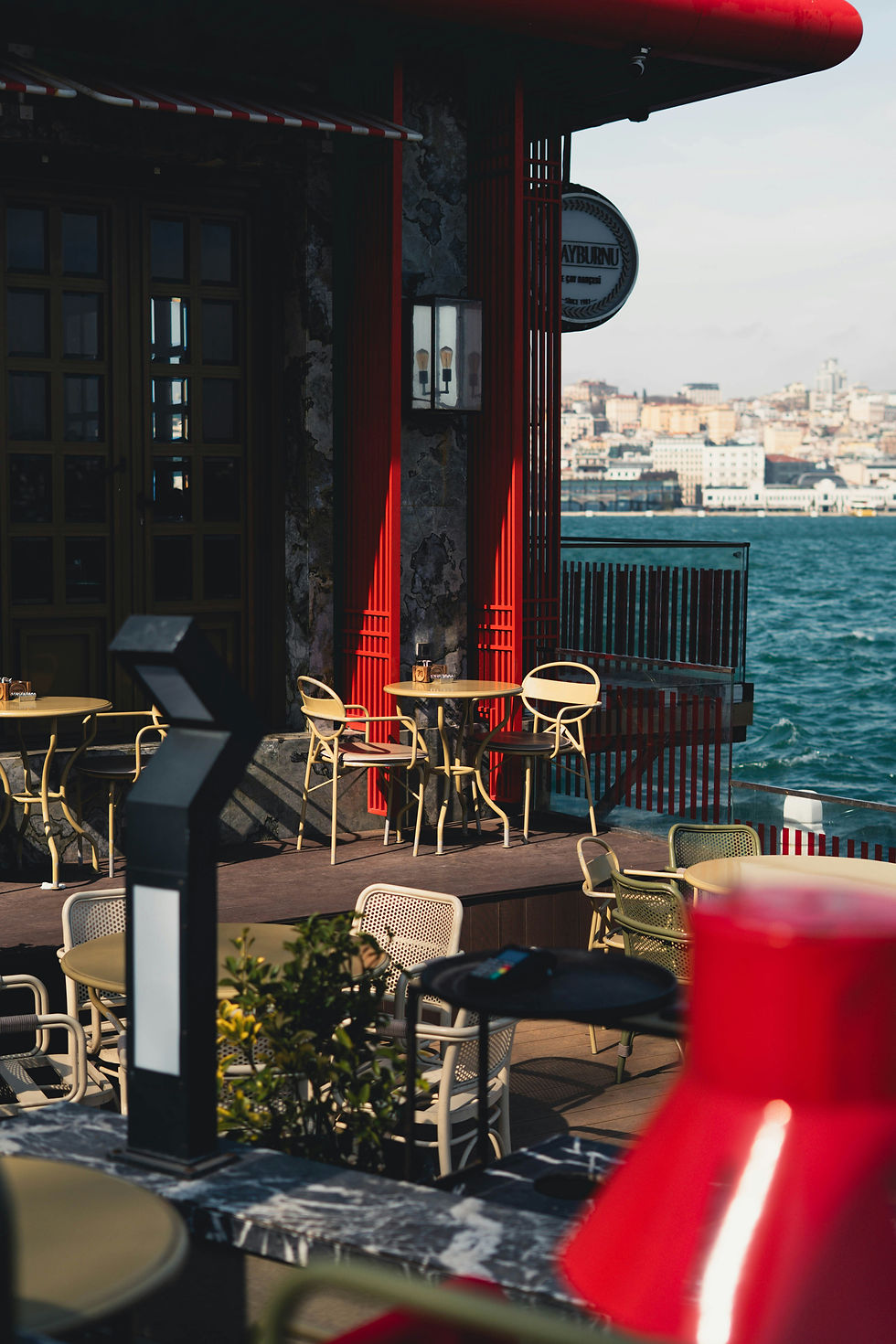
Order the sea bass, order the calamari, and stay later than you planned, because in the evening musicians appear between the tables and Istanbul has always understood that eating well and listening well are not separate activities. The restaurants below the bridge are uneven in quality, as everyone will tell you, and this is true, however it is also true that the setting does a significant amount of the work regardless of what arrives on the plate, and that the skyline beyond the window goes through a sequence of colours at dusk, orange to pink to a deep and specific blue, that Pamuk spent a career finding words for and that is, in the end, simply best seen from a table below the Galata Bridge with something cold in your hand and nowhere else to be.
What the Fishermen Know That the Tourists Do Not

Istanbul is a city that can overwhelm, and the Grand Bazaar, the Hagia Sophia, the Blue Mosque, the weight of what there is to see can produce a particular kind of paralysis, the sense that you are consuming the city rather than experiencing it, processing monuments rather than inhabiting a place. The fishermen on the Galata Bridge have found the antidote to this, and it is deceptively simple.
They do not move, they do not process, and they stand at the railing waiting for something to happen in the water below while in the meantime they watch the city doing its ordinary business: the ferries, the gulls, the trams, the light changing over the Horn as the morning moves into afternoon. They have been doing this long enough that none of it surprises them any more, which means they can simply be present with it instead, and even though that sounds like a small thing, it is in practice the most valuable relationship you can have with a city as dense and as layered as this one.

This is available to anyone with a rod, which can be rented on the bridge for almost nothing, or without one, if standing at a railing and watching the water turns out to be enough. It is enough. Istanbul, as Pamuk noted, requires you to stop in order to see it, and the fishermen stopped a long time ago, and the city came to them.
A Local Guide to the Bridge: What to Do and When

Go early, because the first hour after sunrise is the fishermen's hour: fewer tourists, better light, the specific smell of morning over the Golden Horn before the day's diesel and spice traffic take over. Take the T1 tram to Eminönü if you are coming from the European side, or the ferry from Üsküdar on the Asian side, which arrives at the Eminönü terminal directly below the bridge approach and is itself one of the better ways to arrive anywhere in this city.
Buy the balık ekmek for breakfast, because there is no better argument for getting up early in Istanbul than eating it warm at the water with the city just starting to move around you. Walk across the bridge slowly, stop at the railing, look down at the water, which at certain angles and in certain lights has a quality that oil paint has been trying to replicate for centuries and never quite managed, and notice the rods and the patience of the people holding them.
Go back in the evening for dinner below the bridge, stay until the musicians arrive, and order the raki. Come back the next morning and you will find the fishermen in the same positions, at the same railings, doing the same thing, because Istanbul has been doing this for a very long time and has learned not to be in a hurry about it.

