Why Spring 2026 Belongs to the Mughal Print Girlies

Updated: Apr 22
A cultural meditation on florals, heritage textiles, and the quiet persistence of India’s most enduring design language
By Maheshwari Vickyraj

Every spring the fashion industry rediscovers flowers, although the rediscovery is rarely framed that way. Instead, editors describe a “return to florals,” designers speak of botanical inspiration, and trend forecasters begin the familiar ritual of declaring blossoms newly relevant. Spring 2026 is following that same trajectory. Across the runways of Paris and Milan, floral motifs have reappeared through hand painted prints, embroidered petals, and archival textile references, signalling what many editors are already describing as a renewed fascination with craft driven botanical design.

Yet this annual revival carries a certain cultural irony. For much of the world, florals arrive each year as a seasonal novelty; however, in the Indian subcontinent they have never truly left the cultural imagination. The Mughal empire turned flowers into one of the most sophisticated visual languages in global design history, allowing botanical motifs to travel fluidly across architecture, painting, gardens, and textiles.
What contemporary fashion calls a revival has therefore existed quietly within Indian craft traditions for centuries.
If Spring 2026 is indeed the season of florals once again, then it might also belong to a particular aesthetic archetype quietly emerging within contemporary wardrobes. One might call her the Mughal Print Girl. Not as a fleeting internet persona, but as a cultural inheritor of a visual tradition that has always understood flowers as more than decoration.
The Mughal Fascination With Flowers
To understand why Mughal prints feel unexpectedly resonant today, it is necessary to return to the imperial courts of the sixteenth and seventeenth centuries, when botanical imagery first acquired its remarkable symbolic power.
Under emperors such as Akbar, Jahangir, and Shah Jahan, the Mughal court cultivated an almost scholarly fascination with nature. Jahangir in particular developed a reputation for botanical curiosity, commissioning artists to document individual flowers with extraordinary precision in miniature paintings that resemble scientific studies as much as works of art.

At the same time gardens were being constructed as philosophical landscapes rather than ornamental backdrops. The famed charbagh garden design divided space into four symmetrical quadrants intersected by flowing water channels, a structure intended to evoke the Qur’anic description of paradise. In places such as Shalimar Bagh, flowers were not incidental plantings but deliberate aesthetic gestures that framed architecture, scent, and seasonal experience.
As the art historian Ebba Koch has often noted in studies of Mughal design, the empire’s artistic language developed through a continuous dialogue between nature and ornament.
Flowers therefore became visual metaphors for refinement, order, and transcendence, migrating effortlessly across mediums from marble carvings to manuscript margins and eventually into textiles.
When Botanical Art Became Fabric

The migration of Mughal floral imagery into textile culture remains one of the most fascinating episodes in design history. Art that once adorned palace walls gradually found its way onto cottons, silks, and brocades that circulated through trade networks connecting India with Persia, Europe, and Southeast Asia.
The transformation was not accidental. Textile artisans absorbed the botanical vocabulary of Mughal miniature painting and translated it into repeating patterns that could be block printed or woven into cloth. Small stylised flowers known as buta motifs began appearing across garments and furnishings, forming rhythmic compositions that felt both decorative and contemplative.
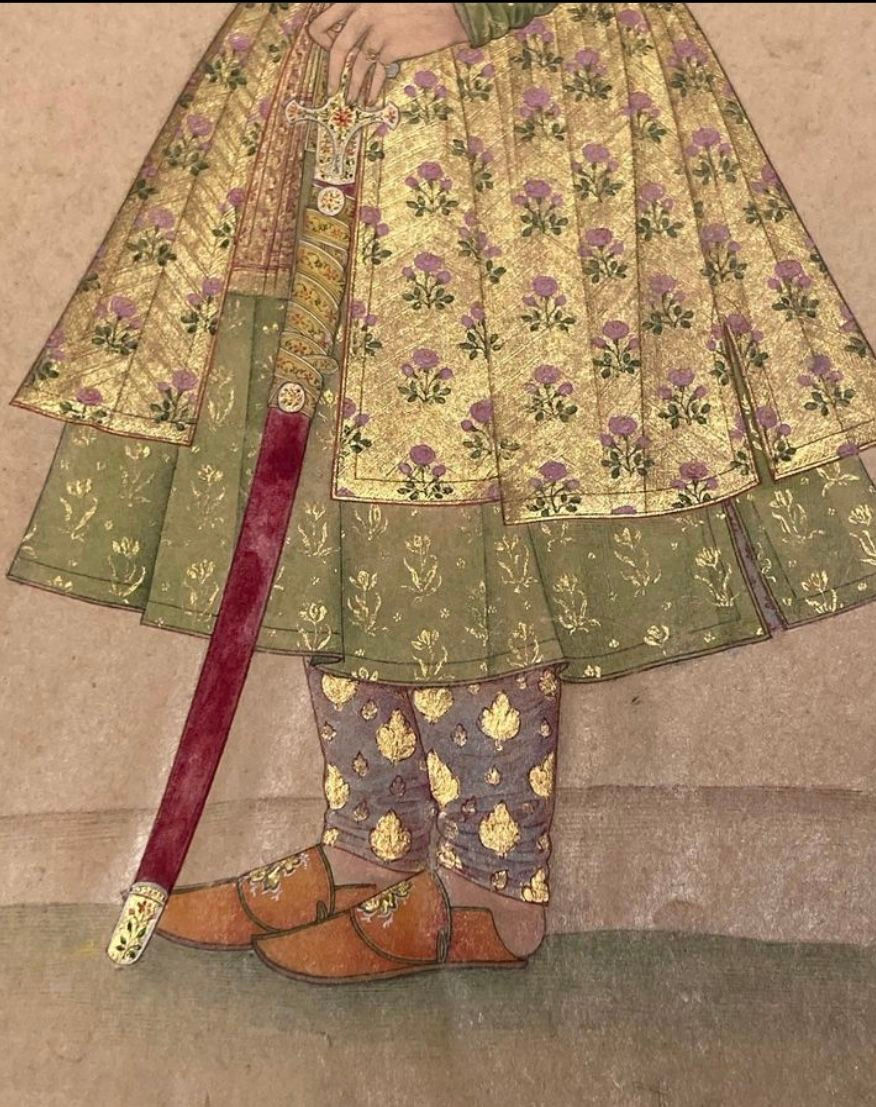
Printed cotton chintz provides one of the most significant examples of this evolution. Originating in India during the sixteenth century, chintz carried intricate floral patterns that captivated European markets and eventually influenced textile design across the continent. What European consumers considered exotic decoration was in fact a continuation of the Mughal empire’s botanical worldview.
The revival of this aesthetic within contemporary fashion has been explored in pieces such as this study of Mughal print resurgence, which traces how heritage motifs have quietly returned through modern design labels and artisan collaborations.
What becomes evident in such analyses is that Mughal prints never disappeared; they simply existed outside the cyclical logic of Western fashion trends.
Why Mughal Prints Feel Contemporary Again

Fashion in the mid 2020s has developed a renewed appetite for heritage craftsmanship. Publications such as Business of Fashion and Vogue have repeatedly noted the industry’s growing interest in slower forms of production and historically rooted design languages. In a commentary on the revival of craft traditions,Who What Wear observed that heritage techniques such as florals are increasingly being viewed not as nostalgia but as the foundation of future luxury.
This cultural shift creates an environment in which Mughal prints feel unexpectedly modern. Their visual language emphasises delicacy rather than spectacle, repetition rather than maximalism. Instead of the oversized florals that dominated previous decades, Mughal motifs rely on smaller blossoms arranged with rhythmic precision, producing garments that feel intimate and quietly intellectual.

There is also a deeper cultural resonance at play. As digital aesthetics become louder and more accelerated, many designers and consumers are gravitating toward visual traditions that offer calm and continuity. Mughal prints possess precisely that quality; they evoke centuries of design evolution without appearing museum bound.
In many ways the Mughal Print Girl represents a contemporary response to this search for grounded beauty.
The Mughal Print Girl in the Modern Wardrobe

Across Indian fashion today, Mughal inspired prints are appearing in ways that feel refreshingly unforced. Rather than staging historical revivalism, designers are translating botanical heritage into silhouettes that suit contemporary life.
At Good Earth, the Mughal garden continues to serve as an enduring source of inspiration. The brand’s textiles and garments frequently feature delicate floral buta patterns derived from miniature paintings, allowing historical imagery to inhabit relaxed cotton kurtas and flowing dresses that feel unmistakably modern.

Meanwhile Nicobar approaches Mughal motifs through a minimalist lens, pairing botanical prints
with breezy silhouettes that seem designed for coastal afternoons and slow urban mornings alike.
Other labels have embraced the Mughal vocabulary with equal nuance. Raw Mango frequently references historical textile traditions within its collections, weaving archival motifs into contemporary saris and garments that maintain a quiet sense of regality. Anokhi continues to champion the hand block printing techniques that preserve Rajasthan’s centuries old floral patterns, while Okhai collaborates with rural artisans to reinterpret heritage motifs for modern wardrobes.
Designers such as Injiri and Pero approach Mughal florals with a slightly more experimental sensibility, allowing irregular block prints, hand embroidery, and layered textiles to create garments that feel both archival and contemporary.
How to Embrace Being a Mughal Girlie This Spring

Embracing the Mughal aesthetic this spring is less about costume and more about sensibility. The Mughal Print Girl gravitates toward breathable fabrics such as cotton, mulmul, and Chanderi that allow floral motifs to feel effortless rather than ornamental.
Her wardrobe often carries small repeating botanical prints rather than oversized florals, echoing the buta patterns that once appeared in Mughal manuscripts and textiles.
There is also an ease to the palette, where pistachio greens, faded rose tones, indigo blues, and warm ivories mirror the colours of Mughal gardens and miniature paintings. Paired with simple silver jewellery, leather juttis, or woven bags, the look becomes less about trend adoption and more about inhabiting a lineage of textile beauty that has always existed quietly within Indian craft.
A Cultural Archetype Rather Than a Trend

The idea of the Mughal Print Girl therefore resists the language of trends. She is not performing historical nostalgia, nor is she attempting to replicate imperial aesthetics. Instead she occupies a space where heritage becomes lived experience, where the botanical motifs scattered across a cotton kurta quietly echo centuries of artistic exploration.
In a reflection on contemporary fashion culture, an editor at Vogue once wrote that true style often emerges not from invention but from the rediscovery of what already exists. The Mughal print revival feels like precisely that kind of rediscovery.
Spring 2026 may be filled with florals across global runways, yet within India those flowers carry a deeper lineage. They speak of gardens designed to resemble paradise, of painters who studied petals with scientific devotion, and of textile artisans who translated those visions into cloth that could travel across continents.
The Mughal Print Girl does not simply wear florals this season. She inhabits a tradition that has always understood their meaning.

Fashion tends to frame beauty as something cyclical, arriving and disappearing with each passing season. Mughal florals remind us that certain design languages operate on a different timeline altogether.
The small blossoms scattered across Mughal textiles are not seasonal motifs waiting for revival. They are fragments of an empire’s aesthetic philosophy, carried patiently through centuries of craftsmanship.
If florals dominate the visual language of Spring 2026, then the Mughal print tradition offers a quiet reminder that some gardens have never stopped blooming.

